12 Signs Your Elderly Parent Needs Non-Emergency Medical Transport, Not Their Own Car
Worried about a parent driving to dialysis or doctor visits? Here are the warning signs it's time to switch to non-emergency medical transport, plus how to start the conversation.
Most families don't have "the driving conversation" until something forces it — a fender bender in the Publix parking lot, a missed dialysis appointment, or a phone call that starts with "Mom got a little turned around on the way home." By the time driving becomes an obvious problem, it's often already been a quiet problem for months.
This isn't about whether your parent is a "good" or "bad" driver. Crash-risk research shows older drivers aren't more likely to cause an accident than middle-aged drivers — they're more likely to be seriously hurt when one happens, because aging bodies handle crash forces worse (IIHS, "Older Drivers", 2023). The real question isn't "can they still drive?" It's "what does the drive to dialysis, cardiology, or the ER actually cost them physically, if something goes wrong?"
Below are the signs that typically show up before a crash does, plus what non-emergency medical transport (NEMT) actually looks like once you make the switch.
Key Takeaways
- Drivers 80 and older have a fatal crash rate of 7.9 per 100 million miles driven, more than 3x the rate for drivers in their early 70s (IIHS, 2024).
- Older adults facing transportation barriers are 2.3x more likely to miss doctor visits and 2.5x more likely to miss scheduled medical procedures (BMC Public Health, 2022).
- Florida requires drivers 80+ to pass a vision test at every license renewal, a useful, low-conflict checkpoint for opening the conversation (FLHSMV).
- NEMT services like wheelchair, stretcher, and dialysis transport exist specifically to remove the physical risk of the drive itself, not just the inconvenience.
Why This Conversation Feels So Hard
If it feels awkward to bring up, that's normal — and you're not the only one navigating it. Roughly 79% of the nation's 63 million family caregivers say they provide transportation for an older adult or person with a disability (AARP, "Caregiving in the US 2025"), and nearly half report that caregiving has meaningfully increased their stress levels (AARP, 2024). Driving is tied up with independence, and taking it away — even partially, even just for medical appointments — can feel like taking away dignity.
The good news: switching to medical transport for appointments doesn't have to mean taking away the keys entirely, and it doesn't have to be framed as a loss. Many families start with just the highest-risk trips (dialysis three times a week, chemo, post-surgical follow-ups) and build from there.
The 12 Warning Signs to Watch For
1. Recent fender benders or new dents/scrapes on the car
A parent who suddenly has curb scrapes on the wheels, a dented bumper they can't explain, or a "someone hit me in the parking lot" story more than once in a few months is giving you real data, not just an excuse.
2. Getting lost on familiar routes
Confusion on a drive they've made hundreds of times — to church, the pharmacy, a sibling's house — is one of the more reliable early indicators of cognitive change, and one of the least likely to be self-reported.
3. Missed or rescheduled medical appointments
If your parent has skipped or pushed back a doctor visit because they "didn't feel up to the drive" or "couldn't find parking," transportation has already become the barrier, whether or not anyone's called it that yet. This is common and costly: transportation barriers make older adults over twice as likely to miss physician visits and scheduled procedures (BMC Public Health, 2022).
4. A dialysis, chemo, or dementia diagnosis
Some diagnoses change the driving math immediately. Dialysis patients often leave treatment fatigued, light-headed, or with blood-pressure swings — not a safe state to get behind the wheel three times a week. NEMT for Dialysis Patients in Miami-Dade and Broward covers this in more detail if that's the situation you're facing.
Dementia is its own category. Drivers later diagnosed with dementia had a crash in the prior three years at notably higher rates than matched peers without a diagnosis (43% vs. 30%), and Alzheimer's patients average more than double the annual crash rate of similar-age drivers without the disease (population-based study, NCBI). Nearly 5 million U.S. adults 65+ are currently living with dementia, a number projected to double by 2060 (CDC) — this is not a rare edge case.
5. New vision problems
About 18% of adults over 70 have significant vision problems, including blindness in one or both eyes (NHTSA). Cataracts, macular degeneration, and glaucoma often progress slowly enough that a parent adjusts without noticing how much they've adjusted — driving only in daylight, avoiding highways, hugging the center line.
6. Slower reaction time under pressure
Reaction time naturally slows with age and degrades further under stress — a merge, a sudden stop, a pedestrian stepping off a curb (reaction-time literature summarized via NCBI). A parent who used to handle I-95 without a second thought but now white-knuckles surface streets is telling you something.
7. Taking multiple medications
Around half of active older drivers take seven or more medications, and roughly 1 in 5 take at least one drug flagged as potentially inappropriate for a driver, a combination associated with up to a 300% higher crash risk in AAA's LongROAD study (AAA Foundation for Traffic Safety). If your parent's medication list has grown in the last year, it's worth an honest look at what's on it and how it affects them behind the wheel.
8. A recent hospital stay or ER visit
Post-hospitalization patients are often weaker, more medicated, or still recovering from anesthesia or a procedure — the worst possible condition to drive in, and often exactly when the next follow-up appointment gets scheduled. This is one of the most common reasons families first look into hospital discharge transport, since it covers the ride home and the follow-up visits in the days right after.
9. Difficulty getting in and out of the car unassisted
If getting into the driver's seat now takes real effort — gripping the door frame, a slow lower and twist, needing a hand — that same mobility limitation is going to be a problem at the destination too: parking lots, waiting rooms, exam tables. Wheelchair and ambulatory transportation cover different points on that spectrum; our wheelchair vs. stretcher comparison guide can help you figure out which level of support actually fits.
10. Family members already avoid riding with them
If your kids "conveniently" have somewhere else to be when Grandma offers a ride, or your spouse quietly grips the door handle in the passenger seat, that discomfort is real information — even if no one's said it out loud.
11. They've started avoiding certain conditions
Refusing to drive at night, in rain, on highways, or during rush hour is a common, largely unconscious form of self-regulation. It usually means the driver already senses reduced capability — they just haven't connected the dots to "maybe I shouldn't be doing this drive at all," including the drive to dialysis or an oncology appointment.
12. A citation, warning, or license flag from the DMV
In Florida, drivers 80 and older must pass a vision test at every license renewal, whether that renewal happens in person, by mail, or online, and renewal cycles shift to every six years after 80 (FLHSMV). A flagged renewal, a request for a driving evaluation, or even a close call with a ticket is often the state handing you an opening you didn't have to create yourself.
| Driver age group | Fatal crash rate per 100 million miles driven |
|---|---|
| 70–74 | 2.1 |
| 75–79 | 2.8 |
| 80–84 | 5.3 |
| 85+ | 7.9 |
Source: IIHS, "Fatality Facts 2024: Older People" (2022 mileage-based data)
The pattern is steep, not gradual: risk more than triples between the low-70s and mid-80s. It's also worth noting that IIHS research attributes most of that increase to physical fragility in a crash, not more frequent at-fault driving errors (IIHS, "Older Drivers") — which is exactly why removing the drive to a recurring medical appointment matters more than a blanket judgment about someone's overall driving.
Why the Drive to a Medical Appointment Is the Highest-Risk Drive
Not all trips carry the same risk. A slow Tuesday drive to the grocery store isn't the same as leaving a dialysis session light-headed, driving home from a cardiology appointment after a new blood-pressure medication, or navigating an unfamiliar hospital campus for a specialist visit. Medical trips concentrate exactly the conditions that raise crash risk: fatigue, new or adjusted medications, stress, and unfamiliar routes.
43% of fatal crash involvements for drivers 80+ happen at intersections, compared with about 24% for drivers 20–64 (IIHS) — and hospital and specialist campuses are often built around exactly that kind of complex, multi-lane intersection navigation. It's one more reason the appointment drive, specifically, is worth solving first, even if your parent keeps driving for everything else.
What Non-Emergency Medical Transport Actually Provides
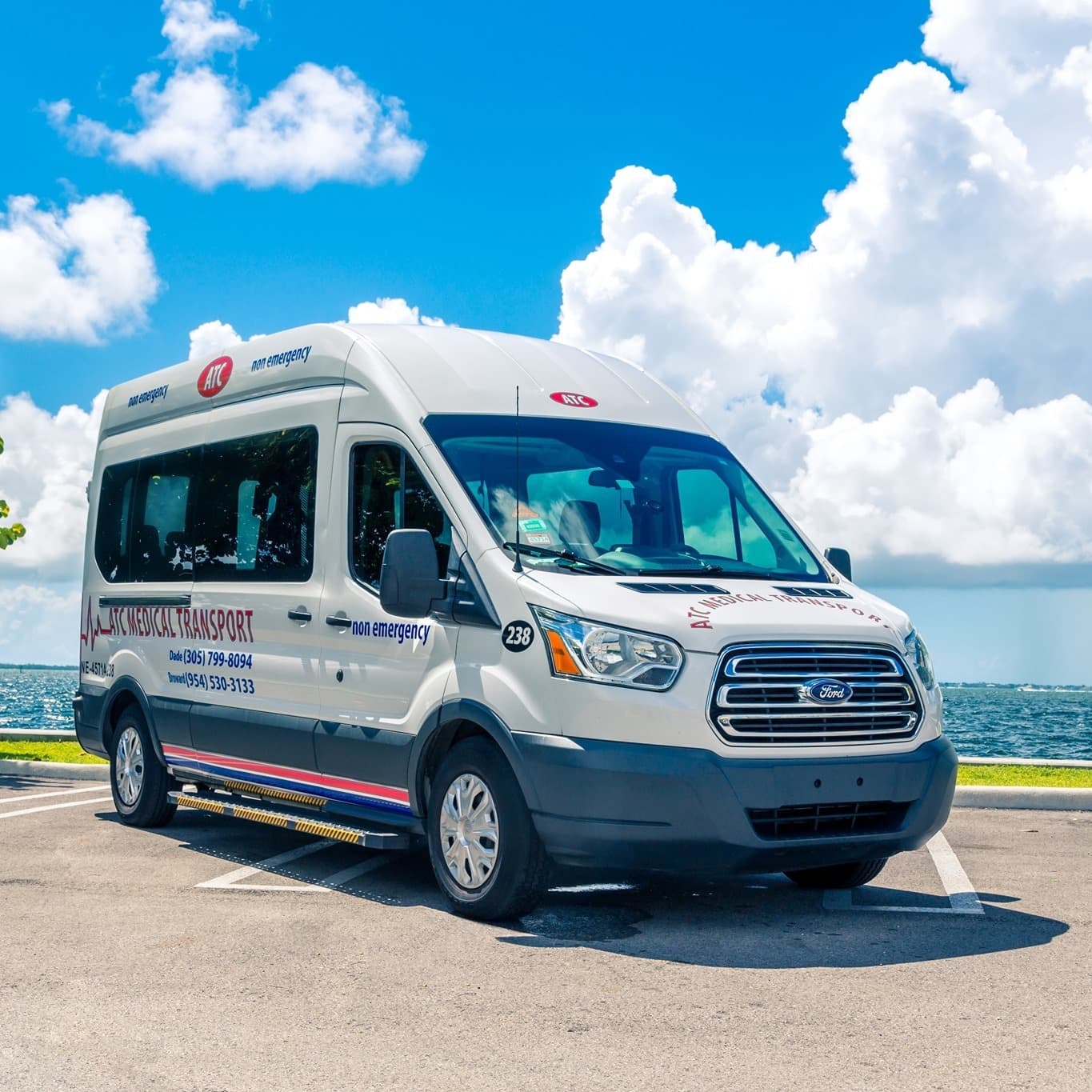
NEMT isn't an ambulance, and it isn't a rideshare either. It's a level of service built specifically around medical trips:
- Wheelchair transportation for parents who use a wheelchair full- or part-time and need a securely restrained ride, not a fold-and-lift into a sedan trunk. See wheelchair transportation services
- Stretcher transportation for parents who can't sit upright for the full trip, often after surgery or during a serious illness. See stretcher transportation services
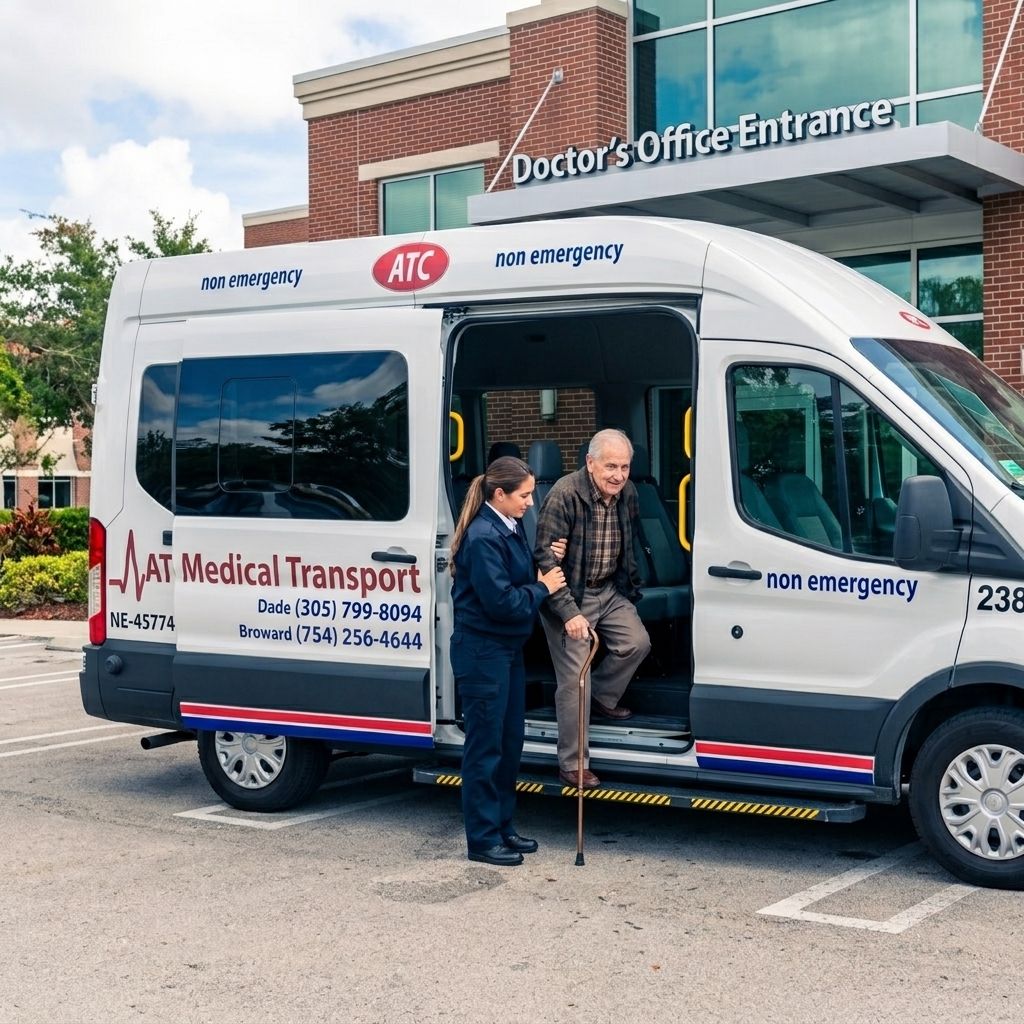
- Ambulatory transportation for parents who can walk but need help with steps, distance, or balance getting from the door to the vehicle.
- Dialysis transportation for the three-times-a-week reality that makes driving themselves particularly risky post-treatment. See dialysis transportation services
- Hospital discharge transport for the ride home after a stay, plus the string of follow-ups that come right after. See hospital discharge transport
- Long-distance medical transportation for the specialist two counties over that a local ride service won't touch.
- Airport and cruise port transfers for parents who still want to fly to see grandkids or take that cruise, just with help managing a wheelchair, luggage, and terminal navigation instead of driving themselves to MIA or Port Everglades.
The point isn't to eliminate your parent's independence — it's to eliminate the specific, elevated risk of them being the one behind the wheel on the trips that matter most for their health.
How to Start the Conversation
- Lead with a specific trip, not a blanket statement. "I'm worried about you driving to dialysis after treatment" lands very differently than "I don't think you should drive anymore."
- Bring data, not just opinion. The Florida vision-test requirement at 80, a recent diagnosis, or a specific incident gives the conversation a concrete anchor instead of feeling like a judgment call.
- Offer a trial, not a permanent change. Suggest medical transport for the next few dialysis sessions or the post-surgery follow-ups, and revisit from there.
- Let them keep some control. If they can still drive to the hairdresser or church safely, say so. This isn't all-or-nothing.
- Loop in their doctor if needed. A physician raising driving safety directly often carries more weight than a family member, particularly around a new diagnosis or medication change.
Choosing the Right Provider in Miami-Dade and Broward
Once you've decided medical transport makes sense, the provider matters. Not every service handles wheelchair securement, stretcher transport, or a recurring dialysis schedule the same way. Our guide on 5 things to look for when choosing a medical transportation company in South Florida walks through licensing, vehicle equipment, and staff training to check before you book. If you're ready to move forward, how to book NEMT in Miami-Dade and Broward County covers the process step by step.
For families managing recurring appointments — dialysis, physical therapy, chemo — our subscription plans are built to make regular trips simpler and more predictable than booking one-off rides every time.
The Bottom Line
The signs above rarely show up all at once — they accumulate quietly over months, usually noticed by an adult child before the parent themselves admits anything's changed. You don't have to solve the whole driving question today. Start with the one drive that worries you most, whether that's dialysis, a post-surgical follow-up, or the next cardiology appointment, and take that risk off the table first.
Ready to set up a ride, or want to talk through which service level fits your parent's needs? Book a ride or contact our team and we'll walk you through it.
Frequently asked questions
NEMT is for stable patients who need help getting to and from scheduled appointments — it isn't equipped or staffed for medical emergencies. If your parent is in acute distress, call 911 instead.
No. Ambulatory transportation is designed for parents who can walk but need assistance with balance, stairs, or getting in and out of a vehicle safely — a wheelchair isn't required.
Pricing depends on trip distance, the level of service needed (ambulatory, wheelchair, or stretcher), and whether the trips are one-off or recurring. Families with regular appointments, such as dialysis, often find a subscription plan simpler to manage than booking each ride individually.
You don't have to force an all-or-nothing decision. Many families start by moving just the highest-risk trips — dialysis, chemo, post-hospital follow-ups — to medical transport while a parent continues driving for lower-stakes errands, then reassess over time.